

The Khyber Pakhtunkhwa government has decided to outsource nearly 2,000 government primary schools to the private sector as part of a major education reform plan. The move comes after the provincial administration previously adopted a similar model for public hospitals. Officials believe the initiative can improve school performance, increase student enrollment, and strengthen education delivery in remote and underperforming areas.
According to the provincial education department, hundreds of schools have already been outsourced, and early results show noticeable growth in student admissions. The government says the new system will help improve accountability, teacher attendance, school management, and learning quality across the province.
KP Government Approves Large-Scale School Outsourcing Plan
The provincial education department confirmed that around 2,000 government primary schools will gradually be handed over to private operators under the approved outsourcing strategy. Officials say the decision was taken after reviewing the poor condition of many public schools, especially in rural and low-enrollment regions.
You can also read: 8171 Online Survey Eligibility
The government believes that involving the private sector can improve efficiency and reduce administrative problems that often affect public education systems. Authorities also claim the plan is designed to increase educational access for children who are currently out of school.
Why the Government Is Outsourcing Schools
One of the biggest reasons behind the decision is the low enrollment rate in many government schools. Several schools reportedly had very few students despite having teachers, buildings, and operational budgets. Officials say outsourcing can help schools attract more students through better management and improved teaching standards.
The government is also focusing on long-term education reforms. By giving schools to private operators under performance-based contracts, authorities hope to create stronger accountability and measurable academic improvement within a short period.
Main Reasons Behind the Outsourcing Decision
- Low student enrollment in many government schools
- Poor management and weak administrative performance
- Teacher absenteeism and operational inefficiencies
- Need for faster education reforms in remote areas
- Desire to improve learning standards and school discipline
- Success of similar outsourcing models in other sectors
Officials believe these changes can help rebuild public trust in government-supported education services.
How the Outsourcing System Will Work
Under the new policy, private organizations or educational operators will manage selected government schools while the government continues providing financial support. The schools will remain under government ownership, but day-to-day administration and operations will be handled privately.
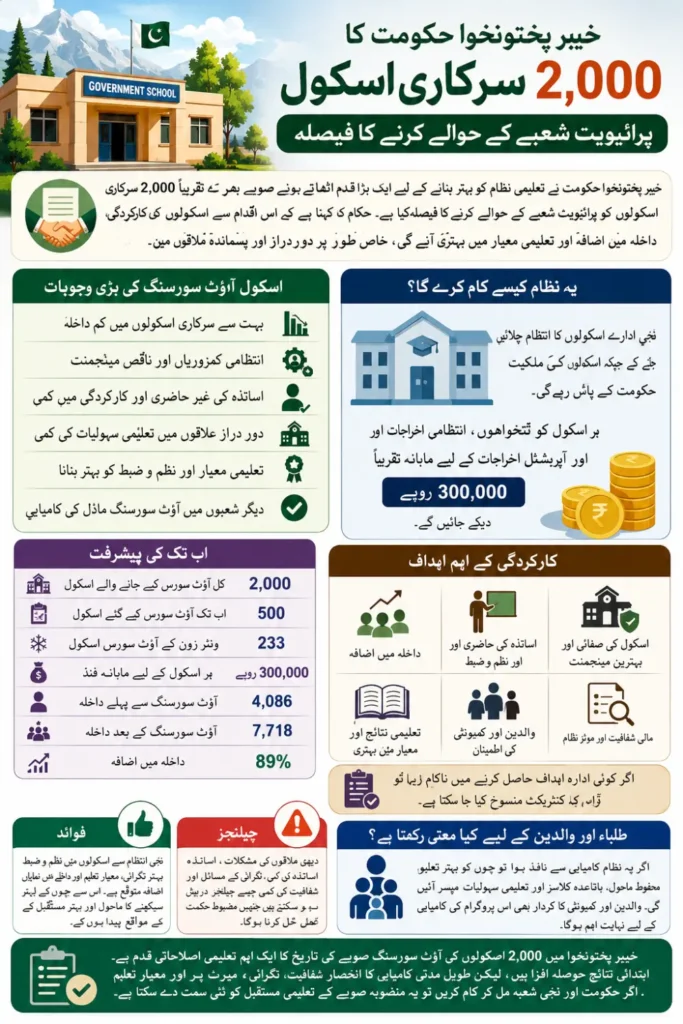
Authorities stated that each outsourced school will receive approximately Rs. 300,000 per month to cover salaries, school management expenses, and operational costs. The funding is expected to ensure smoother school functioning while maintaining educational services for students. 2000 Government Schools Across the Province
Schools Already Handed Over to the Private Sector
Officials revealed that nearly 500 public schools have already been outsourced across the province. Among them, 233 schools located in winter zone areas were included in the early phase of the project due to accessibility and management challenges in those regions.
The education department claims the initial results have been encouraging. According to official figures, student enrollment in outsourced schools increased significantly after management changes were introduced.
Outsourcing Progress So Far
| Category | Number |
|---|---|
| Total schools planned for outsourcing | 2,000 |
| Schools already outsourced | 500 |
| Winter zone schools outsourced | 233 |
| Monthly funding per school | Rs. 300,000 |
| Enrollment before outsourcing | 4,086 |
| Enrollment after outsourcing | 7,718 |
| Enrollment increase | 89% |
The government considers these early figures a positive sign for the future expansion of the program. 2000 Government Schools Across the Province
Student Enrollment Shows Significant Improvement
According to provincial officials, student enrollment in outsourced schools increased from 4,086 students to 7,718 students. This represents an 89% increase after the schools were handed over to private management. Authorities say improved administration and better community engagement played a major role in attracting more students.
The provincial government has now set an ambitious target of increasing average enrollment per school from 40 students to around 180 students within one year. If successful, the initiative could help reduce the number of out-of-school children in several districts.
You can also read: Shahbaz Sharif Income Support Program 2026
Performance Targets Will Decide Contract Continuation
The education department made it clear that private operators will not receive permanent control of schools without results. Contracts may be canceled if institutions fail to meet enrollment targets, management standards, or educational performance benchmarks set by the government.
This performance-based approach is intended to ensure accountability and prevent misuse of public funds. Officials say regular monitoring and inspections will be conducted to evaluate school performance under the outsourcing program.
Key Performance Areas for Private Operators
- Student enrollment growth
- Teacher attendance and discipline
- School cleanliness and management
- Learning outcomes and academic performance
- Parent and community satisfaction
- Financial transparency and operational efficiency
Authorities believe strict monitoring can help maintain quality standards across outsourced institutions.
Benefits and Concerns Around the Decision
Supporters of the policy argue that outsourcing can improve school quality much faster than traditional government reforms. They believe private management may introduce better discipline, stronger monitoring systems, and more effective educational practices.
However, some education experts and public sector supporters have raised concerns about transparency, teacher job security, and long-term sustainability. Critics fear that excessive privatization could reduce direct government responsibility in the education sector if proper oversight is not maintained.
What This Means for Students and Parents
For students and parents, the success of the program will largely depend on whether schools actually deliver better education, safer learning environments, and improved facilities. If managed properly, outsourcing could provide students with more active classrooms, improved attendance systems, and stronger academic support.
Parents are also expected to play a more important role through increased school-community interaction. Many experts believe community involvement will be critical in ensuring private operators remain accountable and focused on student welfare.
Challenges the Government May Face
Although the initial results appear promising, implementing such a large-scale outsourcing project across thousands of schools may not be easy. Rural infrastructure limitations, shortage of qualified teachers, and monitoring difficulties could create challenges during expansion.
The government will also need to ensure transparency in selecting private operators. Without strong oversight, there is a risk that some schools may fail to maintain quality standards despite receiving public funding. 2000 Government Schools Across the Province
You can also read: Big Relief for Motorists in KP Despite
Conclusion
The decision by the Khyber Pakhtunkhwa government to outsource nearly 2,000 government schools marks one of the province’s largest education reform initiatives in recent years. Early enrollment data suggests that the policy may help improve student participation and school performance if implemented effectively.
However, long-term success will depend on proper monitoring, accountability, transparent management, and consistent educational quality. If the government successfully balances private management with strong public oversight, the initiative could reshape the future of primary education across the province.