

A spent SpaceX Falcon 9 rocket stage crashed into the Moon after drifting through space for nearly 18 months, creating global interest among astronomers and space enthusiasts. Although the event happened on the Moon not in South Korea it gained worldwide attention after South Korea’s Korea AeroSpace Administration (KASA) released rare images showing the lunar surface before and after the impact.
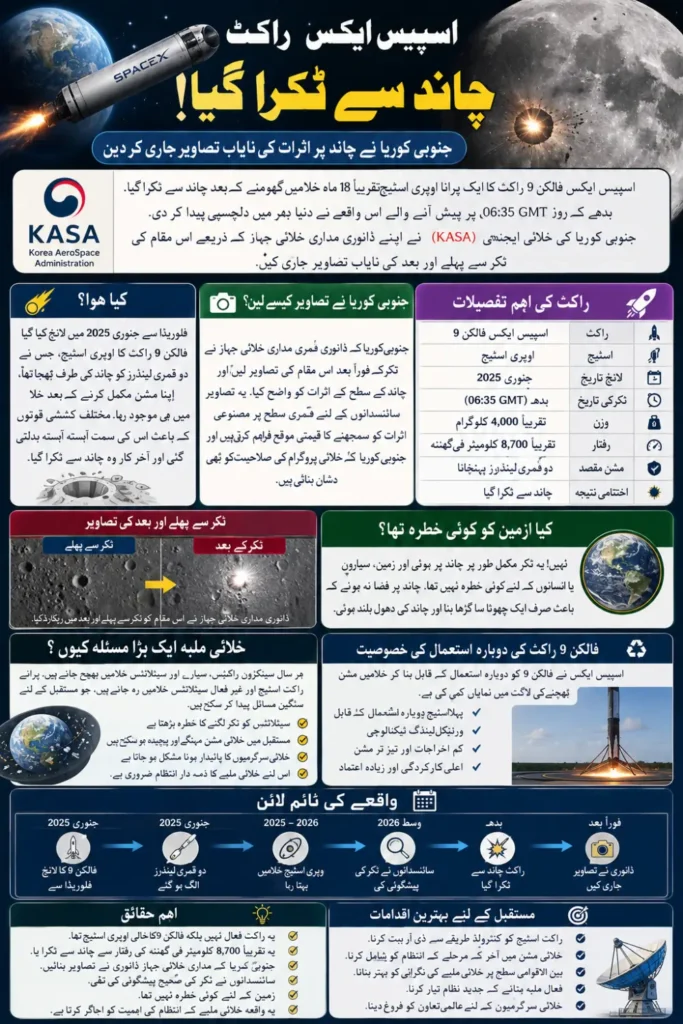
The event highlighted both the impressive capabilities of modern lunar observation technology and the growing concern over space debris. While the collision posed no risk to Earth, experts believe it serves as another reminder that managing abandoned spacecraft and rocket parts will become increasingly important as space exploration expands.
What Happened During the SpaceX Rocket Moon Crash?
On Wednesday at approximately 06:35 GMT, a discarded upper stage of a SpaceX Falcon 9 rocket impacted the Moon after spending about a year and a half traveling through space. Scientists had been tracking the object for months and accurately predicted where and when the collision would occur.
You can also read: She Threads Apply Online Step by Step Full Details
The impact produced a brief flash of light, but it was too faint for most amateur astronomers to observe. Large observatories and lunar orbiters, including South Korea’s Danuri spacecraft, successfully recorded images of the impact area, providing valuable scientific data about the collision.
Why South Korea Released the Moon Impact Images
South Korea’s Korea AeroSpace Administration (KASA) operates the Danuri lunar orbiter, which circles the Moon collecting scientific observations. Shortly after the collision, Danuri photographed the crash site and released comparison images showing the lunar surface before and after the impact.
These photographs gave researchers an opportunity to examine how an artificial object affects the Moon’s surface. The images also demonstrated the growing capabilities of South Korea’s space program and its contribution to international lunar research.
Which SpaceX Rocket Hit the Moon?
The object that struck the Moon was not an active spacecraft but the empty upper stage of a Falcon 9 rocket launched from Florida in January 2025. Its original mission was to send two private lunar landers toward the Moon.
After completing its job, the upper stage remained in a highly elliptical orbit around Earth. Over time, gravitational forces from the Earth, Moon, and Sun slowly altered its path until it eventually collided with the lunar surface.
Falcon 9 Upper Stage Overview
| Feature | Details |
|---|---|
| Rocket | SpaceX Falcon 9 |
| Stage | Upper Stage |
| Launch Date | January 2025 |
| Impact Date | Wednesday (06:35 GMT) |
| Weight | Approximately 4,000 kg |
| Estimated Speed | Around 8,700 km/h (5,400 mph) |
| Mission Purpose | Deliver two lunar landers |
| Final Outcome | Crashed into the Moon |
How Did Scientists Predict the Collision?
Astronomers continuously monitor thousands of satellites, spacecraft, and rocket stages orbiting Earth. Using orbital calculations and gravitational models, they noticed that the Falcon 9 stage was gradually moving toward the Moon.
Several natural forces influenced its path:
- Earth’s gravity
- The Moon’s gravity
- The Sun’s gravity
- Solar radiation pressure
- Long-term orbital changes
These combined effects slowly pushed the rocket stage onto a collision course, allowing scientists to predict the impact with remarkable accuracy.
You can also read: Free Cow and Buffalo Scheme for Rural Women
Did the Moon Crash Affect Earth?
No. The collision posed no danger to Earth, satellites, or people.
Since the Moon has virtually no atmosphere, objects striking its surface simply create small craters and eject lunar dust. Unlike an impact on Earth, there was no explosion visible from our planet and no environmental consequences.
Scientists mainly viewed the event as an opportunity to study impact physics rather than as a hazardous event.
Why Space Debris Is Becoming a Bigger Problem
Although this particular collision was harmless, experts say it highlights the increasing challenge of managing space debris.
Every year, governments and private companies launch more satellites and spacecraft than ever before. Old rocket stages, inactive satellites, and mission hardware often remain in orbit unless they are intentionally removed.
Growing concerns include:
- Increased collision risks
- Damage to operational satellites
- More difficult future launches
- Higher costs for satellite operators
- Long-term sustainability of space activities
Astronomers warn that responsible debris management will become one of the biggest challenges facing the global space industry over the coming decades.
Falcon 9 Reusability Explained
One reason SpaceX has dramatically reduced launch costs is the reusable design of the Falcon 9 rocket.
Unlike traditional rockets that are discarded after launch, Falcon 9 allows major components to be recovered and flown multiple times.
Key features include:
- Reusable first-stage booster
- Vertical landing technology
- Lower launch costs
- Faster mission turnaround
- Improved launch efficiency
However, the upper stage is generally not recovered. After completing its mission, it often remains in space unless mission planning includes controlled disposal.
You can also read: BISE Gujranwala 10th Result 2026
Timeline of the Moon Crash Event
| Date | Event |
|---|---|
| January 2025 | Falcon 9 launches from Florida |
| January 2025 | Two lunar landers separate successfully |
| 2025–2026 | Upper stage drifts through space |
| Mid-2026 | Scientists predict lunar impact |
| Wednesday | Rocket crashes into the Moon |
| Shortly After | South Korea’s Danuri captures impact images |
Key Facts About the SpaceX Moon Impact
Here are the most important points to remember:
- The object was a discarded Falcon 9 upper stage.
- It impacted the Moon at approximately 8,700 km/h.
- South Korea’s Danuri lunar orbiter photographed the impact area.
- No danger existed for Earth.
- Scientists successfully predicted the collision.
- The event highlights the importance of space debris management.
- Falcon 9 continues to be one of the world’s most frequently launched reusable rockets.
The collision also provided valuable scientific observations that can improve future lunar research. Spacex Rocket Moon Crash
Best Practices for Future Space Missions
As space activity increases, experts recommend several measures to reduce orbital debris:
- Plan controlled disposal of rocket stages.
- Design spacecraft with end-of-life disposal strategies.
- Improve international debris-tracking systems.
- Expand active debris-removal technologies.
- Strengthen global cooperation on space sustainability.
These practices will help ensure that future missions remain safe and sustainable.
Common Misunderstandings
Several misconceptions spread quickly after the news broke.
Myth: The rocket crashed in South Korea.
Fact: The rocket crashed on the Moon. South Korea only captured and released images of the impact.
Myth: Earth was in danger.
Fact: The collision posed no threat to Earth or its population.
Myth: SpaceX intentionally crashed the rocket.
Fact: According to SpaceX, the impact was not intentional and resulted from the natural evolution of the rocket’s orbit.
Frequently Asked Questions
Did the SpaceX rocket hit South Korea?
No. The rocket struck the Moon. South Korea became part of the story because its Danuri lunar orbiter captured images of the impact site.
Why was the rocket still in space?
The Falcon 9 upper stage completed its mission and remained in orbit after launching two lunar landers. Over time, gravitational forces redirected it toward the Moon.
Was anyone injured?
No. The collision occurred on the Moon and had no impact on people or infrastructure on Earth.
Can telescopes see the impact?
The flash created by the collision was too faint for most amateur telescopes. Professional observatories and lunar spacecraft were better equipped to observe it.
Why is this event important?
It demonstrates how accurately scientists can predict spacecraft trajectories while also emphasizing the growing need for responsible management of space debris.
You can also read: Banks Directed to Complete Daily
Final Thoughts
The SpaceX rocket Moon crash was not a disaster but a scientifically significant event that showcased advances in space tracking and lunar observation. South Korea’s release of before-and-after images offered rare insight into the effects of an artificial impact on the Moon, while also highlighting the capabilities of its Danuri lunar orbiter.
Perhaps the most important takeaway is the broader lesson about the future of space exploration. As more nations and private companies launch missions beyond Earth, sustainable management of spacecraft and orbital debris will become essential. Events like this not only deepen our understanding of the Moon but also encourage greater international cooperation to keep space safe for future generations. Spacex Rocket Moon Crash