
Electricity consumers across Pakistan may soon receive significant financial relief as the National Electric Power Regulatory Authority (NEPRA) reviews a major quarterly tariff adjustment request for the January to March 2026 period. According to details shared during a public hearing, power consumers — including users of K-Electric — could benefit from a reduction of approximately Rs. 63.94 billion in electricity charges over the next three months.
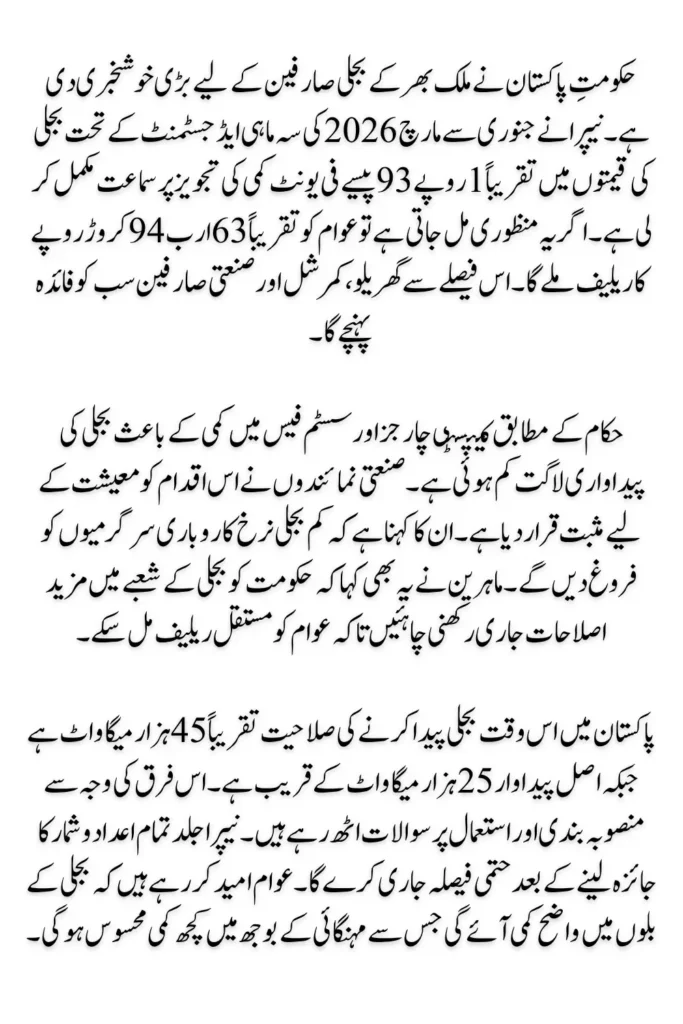
The proposed adjustment includes a possible reduction of Rs. 1.93 per unit in electricity prices, offering much-needed support to households, businesses, and industries already facing inflation and rising living costs. Industry experts and stakeholders have welcomed the move, calling it a positive step toward improving economic stability and reducing pressure on consumers.
You can also read: BISP 8171 Eid ul-Adha Payment 15000
Why NEPRA Is Considering Electricity Tariff Relief
The proposed reduction is part of the Quarterly Tariff Adjustment (QTA) mechanism used by NEPRA to revise electricity rates based on actual costs incurred by power distribution companies during a specific period.
Several major cost components declined during the January–March 2026 quarter, creating room for a tariff reduction. These reductions include lower capacity charges, decreased system usage fees, and savings from incremental energy units.
Key Reasons Behind the Proposed Electricity Price Reduction
| Cost Component | Reduction Amount |
|---|---|
| Capacity Charges | Rs. 36.83 Billion |
| Use of System Charges & Market Fees | Rs. 11.24 Billion |
| Incremental Energy Units Adjustment | Rs. 23.51 Billion |
| Total Estimated Consumer Relief | Rs. 63.94 Billion |
| Expected Reduction Per Unit | Rs. 1.93 |
These savings are now being reviewed by NEPRA before a final notification is issued.
Expected Impact on Electricity Consumers in Pakistan
If approved, the reduction will directly benefit millions of residential, commercial, and industrial electricity consumers across the country. Lower electricity bills could help families manage monthly expenses more effectively while also supporting business operations.
For industries, cheaper electricity may reduce production costs and improve competitiveness. Many industrial stakeholders believe that stable and affordable electricity prices are essential for economic growth, exports, and investment in Pakistan.
Consumers Likely to Benefit
The relief is expected to impact:
- Residential electricity users
- Small businesses and shops
- Industrial consumers
- Commercial electricity users
- K-Electric customers
- Consumers connected to DISCOs across Pakistan
Experts say continued tariff reductions could also improve public confidence in the power sector.
What Industry Representatives Said During the Hearing
Industry representatives attending the NEPRA hearing strongly supported the proposed reduction and urged the government to continue passing on financial savings to consumers whenever possible.
Industrialist Tanveer Bari described the expected Rs. 1.93 per unit cut as an encouraging development. He emphasized that reforms in the energy sector should focus on improving efficiency so that ordinary consumers and businesses can benefit directly from reduced operational costs.
Major Concerns Raised by Stakeholders
During the hearing, several important concerns about Pakistan’s electricity sector were highlighted:
- Electricity generation capacity has reached around 45,000 MW
- Actual electricity generation remains close to 25,000 MW
- Underutilization of power plants continues to increase costs
- Demand growth remains slower than expected
- Older power plants are gradually being phased out
- New generation capacity is still being added
Stakeholders stressed that better planning and utilization of existing resources are necessary to avoid unnecessary financial burdens on consumers.
You can also read: Shahbaz Sharif Eid Package Online
Understanding Quarterly Tariff Adjustments in Pakistan
Quarterly Tariff Adjustments are temporary revisions in electricity tariffs made to reflect actual fuel costs, capacity payments, and operational expenses faced by power companies. These adjustments can either increase or decrease electricity prices depending on market conditions.
In Pakistan, tariff adjustments often become necessary because fuel prices, exchange rates, and energy generation costs fluctuate throughout the year. When costs decline, NEPRA can pass the savings on to consumers in the form of lower electricity rates.
How the QTA System Works
Here is a simple overview of the process:
- Power companies submit cost data to NEPRA
- NEPRA reviews operational and generation expenses
- Public hearings are conducted
- Stakeholders provide feedback
- NEPRA issues a final determination
- Adjusted electricity rates are implemented
This mechanism is designed to maintain transparency and ensure consumers are charged fairly.
How Much Relief Could Consumers Receive?
The exact savings for each consumer will depend on monthly electricity usage. However, even a Rs. 1.93 per unit reduction could make a noticeable difference in household and business electricity bills.
For example:
| Monthly Usage | Estimated Monthly Savings |
|---|---|
| 100 Units | Rs. 193 |
| 300 Units | Rs. 579 |
| 500 Units | Rs. 965 |
| 1000 Units | Rs. 1,930 |
Large industrial consumers could see even greater financial relief due to higher electricity consumption levels.
Challenges Still Facing Pakistan’s Power Sector
Although the proposed tariff reduction is positive news, Pakistan’s electricity sector continues to face several long-term structural challenges. High capacity payments, transmission losses, circular debt, and underutilized generation capacity remain major issues.
Energy experts believe that temporary tariff reductions alone cannot solve deeper sector problems. Sustainable reforms, investment in efficient energy infrastructure, and improved governance are necessary for long-term stability.
Common Problems in the Electricity Sector
Some ongoing challenges include:
- Circular debt accumulation
- Electricity theft and line losses
- Expensive capacity payments
- Inefficient transmission systems
- Low recovery rates from some regions
- Dependence on imported fuels
Addressing these issues could help Pakistan achieve more stable and affordable electricity pricing in the future.
Best Practices for Consumers to Maximize Savings
Even with lower electricity rates, consumers can further reduce monthly bills by improving energy efficiency and avoiding unnecessary power consumption.
Simple energy-saving habits can significantly reduce expenses over time, especially during summer months when electricity usage rises sharply.
Useful Electricity Saving Tips
- Use energy-efficient LED bulbs
- Turn off unused appliances
- Avoid excessive air conditioner usage
- Use inverter technology appliances
- Run heavy appliances during off-peak hours
- Regularly maintain electrical equipment
- Unplug chargers and idle devices
These small changes can help households save additional money beyond the expected tariff relief.
What Happens Next?
NEPRA is currently reviewing all submitted figures and stakeholder feedback before issuing its final decision regarding the January–March 2026 quarterly adjustment. Once approved, the revised electricity rates will likely be implemented nationwide, including for K-Electric consumers.
Consumers are advised to monitor official announcements from NEPRA and their electricity providers for updated billing details and implementation timelines.
You can also read: 8171 Validation Status Online Step by Step
Conclusion
The proposed Rs. 63.94 billion electricity relief package could provide meaningful financial support to millions of consumers across Pakistan. A potential reduction of Rs. 1.93 per unit may help lower household expenses, support businesses, and improve overall economic activity during a challenging financial period.
While this development is encouraging, experts believe long-term reforms in Pakistan’s power sector remain essential. Better energy planning, efficient infrastructure, and transparent governance will play a key role in ensuring affordable and sustainable electricity for consumers in the years ahead.