

In Pakistan, the rising cost of electricity and economic challenges have made government relief programs more crucial than ever. Among these, the Punjab Socio-Economic Registry (PSER) and the Cross-Subsidy Program (CSS) stand out as key initiatives designed to support vulnerable households. This article explains how these programs work together to provide relief, how eligible families can benefit, and the importance of accurate registration and verification.
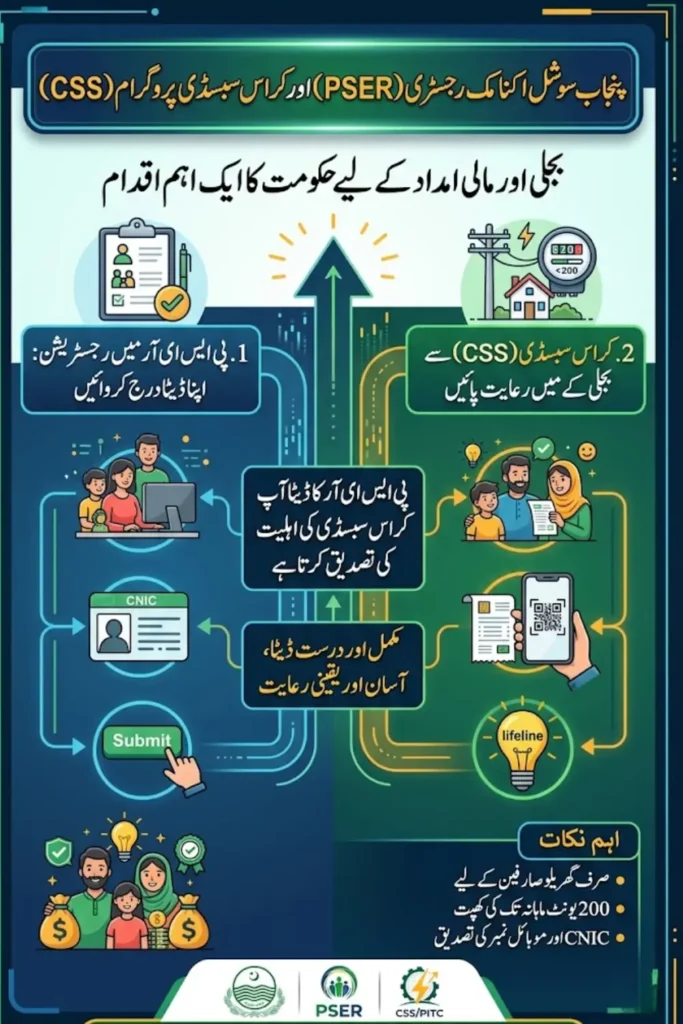
What is PSER and Why Registration Matters
The Punjab Socio-Economic Registry (PSER) is a comprehensive household database created by the Punjab government. It collects detailed information about families, including income, family size, employment status, and living conditions. This data is vital for identifying low-income and vulnerable households who may qualify for various welfare programs.
You can also read: Benazir Kafalat 14500 June 2026 Check Eligibility Criteria
Registering in PSER is the first important step because it officially records your household’s socio-economic status. Without registration, families may miss out on crucial government support such as subsidies, ration assistance, or relief packages. PSER acts as the foundation for many government decisions, making it essential for anyone seeking social protection.
Understanding the Cross-Subsidy Program (CSS)
The Cross-Subsidy Program (CSS) is a government initiative aimed at reducing electricity bills for low-usage households. Typically, households consuming up to 200 units per month qualify for subsidized electricity rates, known as lifeline tariffs. This program helps protect families from rising energy costs by offering reduced tariffs, waived fixed charges, and softened fuel price adjustments.
CSS ensures that subsidies reach the genuine consumers by using CNIC and OTP-based verification through the Power Information Technology Company (PITC). This approach prevents misuse such as secondary meters or commercial conversions, ensuring that relief targets those who truly need it.
How PSER Registration Links to CSS Benefits
PSER registration plays a critical role in the eligibility verification for CSS. The government cross-references household data with electricity consumption records to confirm who qualifies for the relief. Accurate and up-to-date information in PSER helps avoid delays or denials of subsidy benefits.
You can also read: Css.pitc.com.pk Portal
If family data in PSER is incomplete or incorrect, households might face issues when trying to secure subsidies. Therefore, maintaining correct CNIC details, family size, and income information is essential for smooth processing and benefit approval.
Key Differences Between PSER and CSS
| Feature | PSER (Punjab Socio-Economic Registry) | CSS (Cross-Subsidy Program) |
|---|---|---|
| Purpose | Register household socio-economic data for welfare program eligibility | Provide subsidized electricity tariffs to low-consumption homes |
| Data Used | CNIC, income, family size, employment, disability status | CNIC, electricity consumption, meter details |
| Benefit | Eligibility for multiple Punjab government welfare schemes | Reduced electricity bills up to 200 units/month |
| Verification Method | Online portal with CNIC and family details | QR code scan, OTP verification via PITC portal |
| Eligibility Criteria | Household socio-economic status | Residential tariff, consumption limit, single connection |
| Impact | Access to ration, subsidies, financial assistance | Lower electricity costs, waived fixed charges |
Step-by-Step Guide to Checking Eligibility and Subsidy Status
Checking your eligibility for PSER and the CSS electricity subsidy is straightforward with official digital tools:
- PSER Eligibility Check:
- Visit the official PSER Punjab portal.
- Log in using your CNIC or registered mobile number.
- Review your household registration and application status.
- Electricity Subsidy Verification via PITC:
- Locate the QR code on your electricity bill.
- Scan it with a smartphone QR scanner or visit the css.pitc.com.pk portal.
- Enter your 14-digit bill reference number and CNIC.
- Complete OTP verification sent to your verified mobile number.
- Check your subsidy status and confirm if the lifeline tariff is applied.
These steps help you ensure that your household is registered, verified, and receiving the correct benefits without visiting offices or relying on agents.
Key Eligibility Criteria for Cross-Subsidy Program
Households applying for CSS must meet certain conditions:
- Residential Tariff: The electricity meter should be classified for domestic use only.
- Consumption Limit: Average monthly consumption must not exceed 200 units over six months.
- Single Connection: Only one connection per CNIC is eligible for subsidy.
- Welfare Database Match: Must be listed in welfare registries like BISP or NSER.
Meeting these criteria ensures that the subsidy is fairly applied to deserving families while preventing misuse. Cross-Subsidy Program for People Registered in PSER Survey
Common Issues and Solutions in PSER and CSS Verification
Users often encounter problems such as:
- CNIC not found due to incorrect entry or lack of registration.
- Portal slowdowns during peak traffic.
- Mismatched mobile numbers not linked to CNIC.
- Pending verification status causing delays.
Solutions include: double-checking CNIC digits, updating family data through official portals, using PTA-verified mobile numbers, and patiently waiting for processing to complete. Avoid submitting false information to prevent rejection.
Safety Tips to Avoid Fraud and Fake Agents
Due to increasing demand, fake websites and agents may try to exploit users. Protect yourself by:
- Using only official government websites and apps.
- Never paying anyone for registration or subsidy approval.
- Avoiding sharing CNIC photos or OTPs on social media or with strangers.
- Reporting suspicious links or claims to official helplines.
Sticking to official channels ensures the safety of your personal data and reliable access to benefits.
You can also read: Css.pitc.com.pk QR Code Verification Details
Conclusion
The PSER and Cross-Subsidy Program together form a vital support system for low-income households in Pakistan, especially in Punjab. By registering accurately in PSER and verifying electricity subsidy eligibility through CSS, families can ease their financial burden and access government relief.
Use official portals, keep your information updated, and understand the verification process to avoid confusion and fraud. These programs represent a transparent, fair, and accessible way to manage rising living costs amid economic challenges. Cross-Subsidy Program for People Registered in PSER Survey